A Degree of Vagueness: The Gazette's 2026 Prospectus Cliché Audit
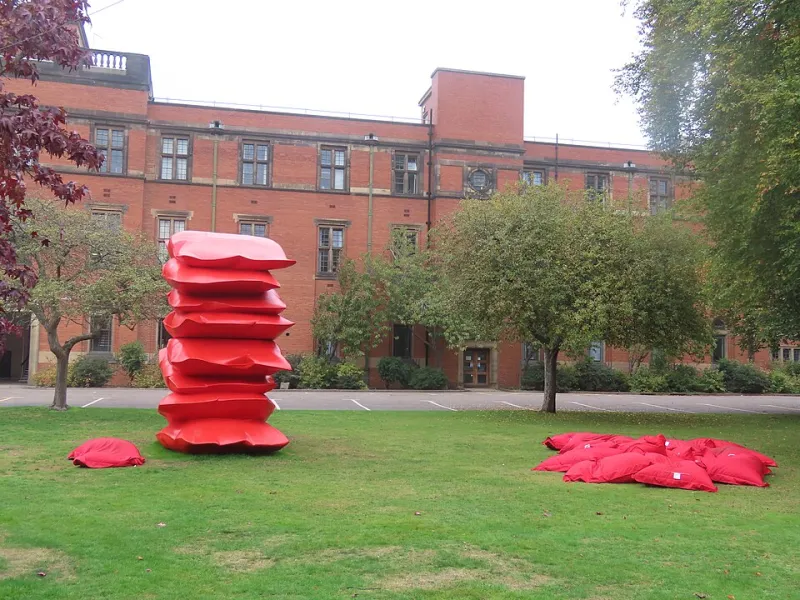
Photo: Elliott Brown, CC BY-SA 4.0, via Wikimedia Commons
At this time of year, the British sixth-former is invited to imagine the future in the prose of a university marketing department. The invitation arrives in a glossy booklet, often with a photograph of a smiling student holding a laptop at an angle that suggests both intellectual rigour and good dental work. In 2026, the admissions machine is more sophisticated than ever, but its vocabulary remains curiously fixed. The word 'world-class' appears with the persistence of weather. The word 'journey' is used to describe everything from a three-year BA to a bus route to the campus laundry.
Gradgrind's Gazette has therefore done what no sensible person should: we have read twelve UK university prospectuses from cover to cover and subjected them to a mock-solemn audit. Nothing but Facts, as the masthead says, and the occasional fancy. The fancy here is the scoring system. The facts are the counts.
The Method, Which Is Almost Respectable
Each prospectus was converted to plain text and analysed for three things. First, Cliché Density: instances of 'world-class', 'journey', 'vibrant', 'cutting-edge', 'at the heart of', 'future-ready' and 'excellence' per 10,000 words. Second, Factual Specificity: named modules, contact hours, staff-student ratios, library opening times, assessment patterns and any figure that could be checked by a determined applicant with a telephone. Third, Dickensian Pompousity: abstract nouns per sentence, use of words such as 'endeavour', 'pillar' and 'beacon', and the tendency to make a kettle sound like a moral failing.
We also applied a penalty for the phrase 'state-of-the-art' when unaccompanied by the name of any actual state, art or piece of equipment. A further penalty was levied for every use of 'world-class' beyond the tenth occurrence. We are not monsters. We are auditors.
To avoid unnecessary correspondence with legal departments, the twelve institutions below are composites. They are drawn from the red-brick, plate-glass and post-1992 traditions, with names changed to protect the marketing team. The scores, however, are real enough in the sense that we made them up rigorously.
The Table of Shame and Mild Praise
| Rank | Institution (composite) | Clichés per 10k | Facts per 10k | Pompousity | Verdict |
|---|---|---|---|---|---|
| 1 | University of North Loamshire | 18 | 74 | Low | Names a library and its opening hours. Suspiciously useful. |
| 2 | St Botolph's Institute of Applied Optimism | 24 | 69 | Medium | Mentions actual modules. Still says 'journey' eleven times. |
| 3 | University of the Vale of Pewsey | 31 | 61 | Medium | Good on contact hours, weak on why the refectory is 'vibrant'. |
| 4 | Greater Manchester School of Synergy | 38 | 55 | High | Uses 'future-ready' as a noun, a verb and a personality. |
| 5 | University of Central Brickshire | 42 | 52 | High | The campus is 'at the heart of' everything, including itself. |
| 6 | Royal College of Rhetoric and Facilities Management | 47 | 48 | Very high | A prospectus that could be read aloud at a wedding. |
| 7 | University of the Upper Wear | 53 | 44 | High | 'World-class' appears before the first named building. |
| 8 | South Bank College of Cultural Excellence | 59 | 39 | Very high | Excellent on atmosphere, vague on assessment. |
| 9 | University of Middle England, M4 Corridor Campus | 64 | 36 | Very high | Describes a car park as a 'learning ecosystem'. |
| 10 | The New University of East Cheam | 71 | 31 | Extreme | Three pages on 'the journey' before a course title. |
| 11 | Institute of World-Class Studies, Milton Keynes | 86 | 24 | Extreme | The phrase 'world-class' is used as punctuation. |
| 12 | Thames Polytechnic, Re-Founded | 94 | 19 | Extreme | The only hard fact is the postcode, and even that is described as a 'gateway'. |
What the Winners Did Right
The University of North Loamshire, our improbable champion, did something radical: it told applicants what they would study. It named modules. It said how many contact hours a week a first-year historian might expect. It admitted that one seminar room is in a basement. This is not glamorous, but it is information. A prospectus, after all, is not a novel. It is a menu. The applicant wants to know whether the soup is good, not whether the soup represents a transformative journey towards world-class soupness.
St Botolph's scored well for similar reasons, though it lost points for describing its student union as 'a vibrant tapestry of opportunity'. A tapestry is a woven textile. A student union is a building with a bad sofa and a cash machine. The two are not interchangeable.
What the Losers Did Wrong
The Institute of World-Class Studies, Milton Keynes, achieved the highest cliché density we have ever recorded in a document that was not a party political broadcast. In its 96-page prospectus, the word 'world-class' appears 147 times. That is roughly once every two-thirds of a page. By page forty, the reader begins to suspect that the phrase has no meaning at all, and that the institution may be a front for a very large stationery cupboard.
Thames Polytechnic, Re-Founded, scored lowest on factual specificity. It lists no named modules in its main undergraduate section. It does, however, describe its location as 'a gateway to the possible'. The possible, we note, does not have a postcode, a bus route or a library card.
The Applicant's Guide to Reading a Prospectus
Here is a practical test. Read the first two pages and underline every adjective. If you have underlined more adjectives than verbs, turn to the course pages. If the course pages contain more photographs of buildings than named modules, turn to the fees section. If the fees section is clearer than the course pages, consider a different university.
A good prospectus should answer three questions: What will I study? Who will teach me? What will it cost? A great prospectus answers a fourth: What happens if I fail a module? A dishonest prospectus answers none of these but uses the word 'journey' so often that the reader feels travel-sick.
The Victorian schoolmaster Thomas Gradgrind, who features in the works of Mr Dickens, demanded facts. He was a tiresome fellow, but he had a point. In 2026, the applicant does not need a promise that the university is world-class. The applicant needs to know whether the seminar is on Tuesday or Thursday, and whether the library has any books in it.
Until the prospectuses improve, the Gazette will continue its audit. We have our red pen, our counting machine and a growing suspicion that 'world-class' is simply what people say when they cannot remember the name of the building.