The 8:14 to Fact: Britain's Timetable as Unfinished Novel
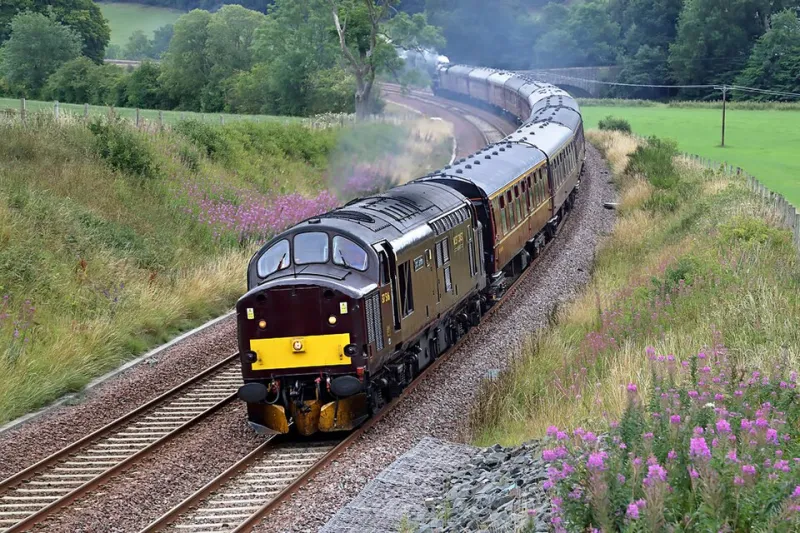
Photo: Walter Baxter , CC BY-SA 2.0, via Wikimedia Commons
There is a moment, familiar to every commuter, when the departure board ceases to be an instrument of information and becomes a work of suspense. The 8:14 to London Waterloo is 'on time'. Then it is 'delayed'. Then it is 'delayed' with the weary specificity of a number, and the platform fills with people who have begun to read the board as one reads a novel: anxiously, looking for clues, distrusting the author.
The comparison is not as fanciful as it sounds. In Britain, the railway timetable has been a literary form since the Victorians. It has plot, structure, recurring characters and a moral universe in which lateness is sin and connection is grace. In 2026, the real-time departure board is merely the latest edition of a text that began with George Bradshaw and has never quite gone out of print.
Bradshaw and the Birth of the Factual Serial
George Bradshaw published his first railway guide in 1839, at the beginning of the railway mania that would rearrange the British landscape with the confidence of a bad novelist rearranging a plot. The guide was not a novel, but it was serial in nature: updated, expanded, corrected and reissued, with stations appearing and disappearing like characters in a long-running drama. It told travellers what time the train left, what it cost, and where they might find a decent chop. It was, in its way, a portable civilisation.
Dickens knew this. He was a railway writer as well as a railway passenger, and the railway appears in his fiction not as a backdrop but as a narrative engine. In 'Dombey and Son', the railway is both progress and menace. In 'The Signal-Man', the timetable is a ghost story: the signalman's duties are governed by time, and the horror lies in the possibility that the schedule may be telling the truth. In 'Mugby Junction', a Christmas number from 1866, the railway junction becomes a place of intersecting lives, which is precisely what a timetable is: a diagram of people almost meeting.
The Timetable as Plot
A timetable has a plot because it has a beginning, a middle and an end, and because it is full of possible failure. The 8:14 leaves at 8:14, unless it does not. The connection at Crewe is guaranteed, unless it is not. The final train home is a deadline in the oldest sense: miss it and you enter the subplot of the station hotel.
This is why railway anxiety feels literary rather than merely administrative. A cancelled train is not just an inconvenience; it is a breach of narrative contract. The author has promised that the 8:14 exists, and now the author is standing on the platform saying, with the blank face of a unreliable narrator, that the 8:14 has never existed and that you should have taken the earlier one.
Victorian serial fiction depended on exactly this kind of suspense. Readers waited for the next instalment; commuters wait for the next announcement. The cliffhanger is the same mechanism, whether the hero is tied to a railway line or the heroine is stranded at Didcot Parkway with a coffee and a dying phone.
The National Character in Small Print
There is a particular British comedy in the timetable's combination of precision and chaos. The document is printed in a font that suggests absolute authority. It lists times to the minute. It uses symbols that require a glossary. And yet the entire system is held together by weather, engineering works and the collective optimism of people who believe that a train can be both 'delayed' and 'on time' in the same sentence.
Abroad, timetables can be more aspirational. In Britain, they are a form of moral instruction. The passenger who arrives early is virtuous. The passenger who runs for the doors is reckless. The passenger who asks a member of staff a question is either brave or foolish, depending on the station. The timetable does not merely tell you when the train leaves; it tells you what kind of person you are for caring.
The Digital Edition
The real-time departure board has changed the text but not the genre. It is now a live serial, updated every minute, with the added tension of a screen that refreshes while you are reading it. The old printed timetable was a promise. The new board is a negotiation. It says 'delayed' and then, after a pause, 'expected at 8:27'. It is the literary equivalent of a narrator who assures you that everything will be fine while the house burns down behind him.
And yet the timetable remains Britain's most widely read factual prose. More people consult a departure board in a week than will read a literary novel in a year. It is a text written by committees, read by millions and judged entirely on whether it delivers. No critic has ever reviewed a timetable, but every commuter has.
The Last Connection
The Victorians understood that punctuality and storytelling are entangled. A train that arrives on time is a sentence that ends properly. A missed connection is a plot twist. A replacement bus service is a digression, possibly by a different author, probably in the rain.
In 2026, the British railway timetable continues to be what it has always been: a factual document with a novelist's sense of timing. It tells us when we will arrive, and it reminds us that we may not. It is, in its own severe way, a work of national literature. Gradgrind would have approved of the facts. Dickens would have appreciated the suspense.
The 8:14, meanwhile, is delayed. The board says so. The plot thickens.